











PREV POST
Stop Sleeping with Dust Mite Allergens – Your Sinuses Will Thank You


Sinus Allergies
Research conducted by IMU University and the University of Nottingham Malaysia, in collaboration with Medklinn, explores how controlled ozone exposure affects house dust mites and their allergen-related proteins.

They are too small to see, but dust mites can be found in many of the places we spend time every day.
House dust mites commonly live in mattresses, pillows, bedding, carpets, sofas and other fabric-rich areas. Their waste particles and body fragments can contain allergens that may trigger sensitivities in some people, including those who experience sinus or allergy-related symptoms.
Keeping indoor spaces clean, washing bedding regularly and managing dust are important steps in reducing exposure.
But while visible dust can be cleaned away, some of the things within our indoor environment are too small to see.
That is why Medklinn, together with IMU University and the University of Nottingham Malaysia, explored how controlled ozone exposure interacts with house dust mites under laboratory conditions.
In the published study, “Effects of ozone exposure on house dust mites,” researchers explored how controlled ozone exposure affected house dust mites (Dermatophagoides farinae) under laboratory conditions.
The study looked at several areas, including:
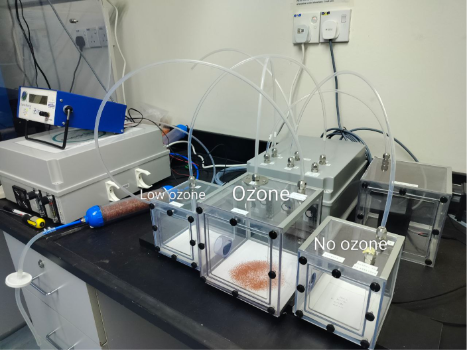
To conduct the study, dust mites were exposed to different ozone concentrations over different periods of time in controlled laboratory chambers.
The ozone used in the study was generated using a custom Medklinn ozone generation system incorporating Cerafusion™ Technology.
One of the clearest findings was that dust mite mortality increased with both ozone concentration and exposure duration.
In simple terms, higher ozone concentrations and longer exposure periods resulted in greater effects on dust mite survival.
This demonstrates that controlled ozone exposure can directly affect house dust mites under the laboratory conditions studied.
The researchers also examined how dust mites responded when exposed to an ozone-treated environment.
The mites predominantly remained in the area without ozone, suggesting an avoidance response.
Their movement also decreased as ozone concentration increased.
This showed that ozone exposure affected not only dust mite survival, but also their movement and behaviour.
The study also examined Der f 1, one of the major allergen-related proteins associated with Dermatophagoides farinae.
The researchers observed a concentration- and time-dependent reduction in Der f 1 protein intensity following ozone exposure.
Together, these findings provide a broader understanding of how controlled ozone exposure can interact with house dust mites — affecting their survival, behaviour and allergen-related proteins.
For people who are sensitive to dust mite allergens, maintaining a clean indoor environment can be an important part of managing everyday exposure. Regular cleaning, washing bedding and reducing dust build-up remain essential steps.
The findings from this study offer another perspective on indoor allergen concerns. Under controlled laboratory conditions, ozone exposure affected dust mite survival, movement and Der f 1 protein intensity.
For Medklinn, these findings contribute to our continued exploration of how Cerafusion™ Technology can be applied as part of a broader approach to indoor protection.
Cerafusion™ Technology generates Active Oxygen, including controlled ozone and negative ions, as part of Medklinn’s Air+Surface Sterilization approach. Rather than simply filtering particles, the technology is designed to work within the surrounding environment.
This provides another approach to maintaining the indoor environment, working alongside regular cleaning and hygiene practices.
Because some of the things that affect our indoor environment are the things we cannot see.
Interested in the science behind the findings?
Read the full published study to learn more about the methodology, experiments and findings.
Reach the Full Research Article here →
Cross Infections
17
Bad Smell
9
Sinus Allergies
4
Customer Success Stories
27
Press Releases & Media Coverage
8
Personal Solutions
72
Technology
14
News & Events
9
Collaborations
1
Ozone Water
1
Ozone Terminology
5
Indoor Environmental Issues
9
Hand Foot & Mouth Disease (HFMD)
2
Mould
3
Business Solutions
27


Why Medklinn
Support
Other Information
Medklinn Showroom & Service Centre
Medklinnn International Sdn Bhd
200901002608 (845537-V)
22, Jalan Pengacara U1/48,
Kawasan Perindustrian Temasya,
40150 Shah Alam, Selangor
Mon-Fri (9am-6pm)
Email: customercare@medklinn.com